


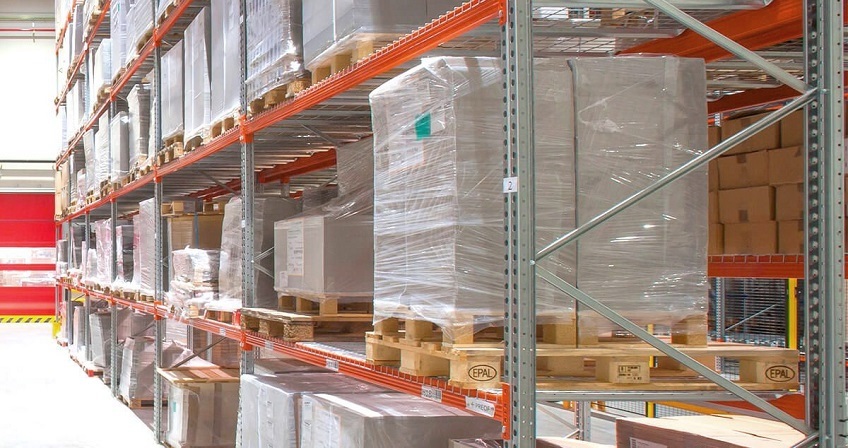
Palletizing is a key element of logistics and warehouse space optimization. Considering that the movement of huge volumes of goods within and outside the country is continuous, a well-functioning process of reliable packaging is very important. Let’s find out what palletizing is, what its features are and what pallets are used for this method of packaging.
What is palletizing cargo
Palletizing is, first of all, the creation of a universal cargo unit, which is convenient to work with further: storage, transportation, etc. Cargo for packing is placed on a unified flat deck – a pallet (pallet).
Proper packaging in compliance with the rules of palletizing allows to simplify picking, storage and accounting of goods, reduce the cost of their transportation and ensure their safety. Goods packed according to all palletizing rules are securely fixed on the pallet and protected from spoilage.
Benefits of palletizing
First of all, palletizing helps to comply with the rules of cargo transportation. In addition, the maintenance of well-packed goods in the warehouse is simplified and unloading and loading processes are accelerated. That is, it saves money and time for warehousing and transportation, especially when it comes to a large batch of goods.
Pros of palletizing:
- the fixed load is held securely in position on the pallet;
- reduces the risk of contamination and spoilage of goods during transportation and storage;
- increases the speed of storage operations and optimizes storage space;
- accounting of both transportation units and individual goods is simplified, as the cargo is clearly visible.
Materials for palletizing pallets
The palletizing process itself takes place in the warehouse. The goods are first stacked on top of each other or in a brick-and-mortar fashion. The heaviest items should be placed at the bottom and the lighter items at the top.
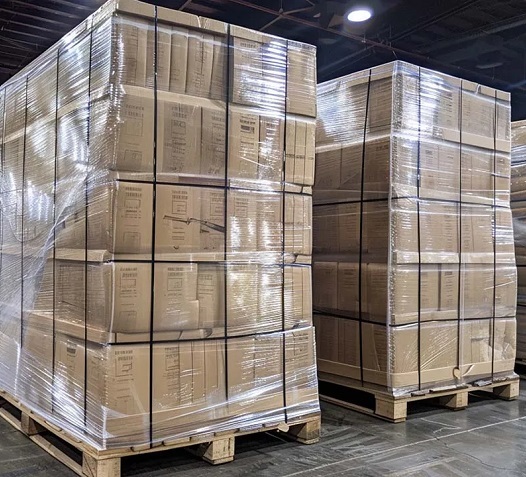
They fix the products on the pallet by means of proper stacking (i.e. using their own weight), as well as using different materials and palletizing schemes.
Loads can be secured with fastening straps and protected by wrapping in polymers. Shrink or stretch films, three-layer sleeves (stretch hood) and reinforced scotch tape are used for more secure fixation.
Delicate cargo is additionally provided with a layer of bubble wrap.
It is impossible not to mention the types of pallets for which this method of cargo packaging is applicable. The most popular in the domestic and foreign markets are wooden unified pallets. These include Euro pallets, standard pallets 1200×800 mm, as well as pallets 1200×1000 mm (otherwise known as finpallets) and 1200×1200 mm (Americans).
Pallets for palletizing are used of 1 and 2 grades, they can also be new or used pallets. The load capacity of new Euro pallets reaches 2.5 tons, typical pallets of the same size and 1200×1000 mm – from 700 kg to 1.5 tons, depending on the type of design and condition.
Types of palletizing
There are two methods of palletizing freight. Each has both advantages and disadvantages, which should be considered as features and used for their own benefit.
Manual palletizing
Manual palletizing is the packing of goods without the use of machinery. The goods are first placed on the pallet, following the rules. Among other things, it should be taken into account that the edges of the goods should not extend beyond the load deck area (maximum allowable error of 2 cm). Next, the packers wrap the goods in stretch film using only hand tools.
This is the most common method of packaging. Its advantages are its simplicity and lack of complex machinery. The disadvantages include low productivity and human factor – the possibility of errors in film winding (insufficient or excessive tension, wrong number of layers).
Automatic machine palletizing
Palletizing can be automated with special devices. Auto-packers work quickly, strictly according to the program and can wrap loads in three planes. The obvious advantages are accurate operation and high productivity. These factors are important in large warehouses with a large volume of goods. At the same time, they require maintenance and servicing, as well as programming when changing operations or pallet types.
Conclusion
Palletizing pallets has become an almost mandatory step in the overall logistics process. It helps to optimize warehousing operations, protect goods from damage and make their transportation safe. Everyone benefits as a result – from the supplier to the recipient.